Line Art Woman Hand: A Designer’s Real-World Embroidery Review
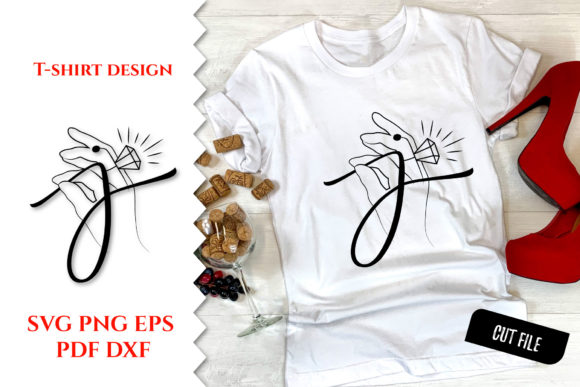
As a designer who’s stitched over 200 custom embroidery projects — from boutique aprons to baby onesies and Etsy bestsellers — I opened Line Art Woman Hand expecting something delicate, but not quite what I got: quiet confidence. It’s a monogram-style illustration built around a single woman’s hand, a subtle diamond motif, and the calligraphic letter “J” — all rendered in clean, unbroken line art. No heavy fills, no gradients, no visual noise. Just intention.
First Impressions: Simplicity That Speaks Before the Needle Moves
The moment you see Line Art Woman Hand, it reads as refined — not fussy, not trendy, not overly literal. The hand is stylized but anatomically respectful; the diamond sits just above the wrist like a quiet emblem, not a flashy gem; the “J” flows from the fingertips with soft, rhythmic curves. This isn’t a design shouting for attention. It’s the kind that earns it — slowly, steadily — on a linen tea towel, an organic cotton tote, or the chest pocket of a relaxed-fit sweatshirt.
I tested it as a centerpiece for a custom embroidered canvas tote bag — one destined for a small-batch gift shop. Printed mockups looked elegant, yes — but the real test came when I digitized it (or rather, reviewed the supplied embroidery file) and ran a stitch-out on medium-weight twill. The lines held. No feathering. No skipped stitches. Even at 3.2 inches wide — my go-to size for tote front panels — every curve stayed crisp. That tells me the original vector was well-drawn and the embroidery file respects its integrity.
Where It Shines (and Where It Asks for Thought)
Line Art Woman Hand excels in contexts where subtlety equals sophistication: personalized baby embroidery on a muslin swaddle, minimalist nursery decor on a pillow cover, or a quiet signature on a chef’s apron. It works beautifully for sweatshirt embroidery — especially on midweight fleece — because the line weight translates cleanly into running stitch or fine satin stitch without needing dense fill areas.
It also lands well as an embroidered patch. The clean silhouette means clean edges after cutting, and the open negative space between fingers and diamond lets fabric breathe — critical for comfort on garments worn daily.
But here’s where practicality kicks in: Line Art Woman Hand doesn’t forgive poor stabilizer choice. On thin cotton tees? Use cutaway + tear-away combo. On stretchy jersey? Skip the hoop-only approach — baste first. And if you’re stitching it onto dark fabric, test thread contrast early: light gray or heathered ecru thread reads softer than stark white, preserving the design’s gentle tone.
Small Hoop & Curved Surface Notes
At under 4 inches wide, this fits comfortably in most 4×4 hoops — ideal for caps and curved surfaces. But don’t rush the cap placement. The wrist-to-fingertip flow means orientation matters: rotate it slightly upward on a structured cap front so the hand feels naturally gesturing, not tilted awkwardly. On baby hats or preemie caps? Scale down to 2.5 inches max — any smaller and the “J”’s delicate terminals risk losing definition.
Commercial Use & Customer Trust
For Etsy sellers and small shop owners, Line Art Woman Hand is a quiet value-builder. It’s not a viral trend piece — it’s a brand anchor. Customers recognize it as handmade, intentional, and personal — especially when paired with thoughtful product photography: a close-up of the stitch texture on a cream linen kitchen towel, or the same design mirrored on matching mother-daughter totes.
That said, it doesn’t scream “gift.” It whispers “thoughtful.” So position it right: pair it with warm copy (“For the woman who moves with grace”) instead of generic “Great for Mom!” messaging. It elevates your craft business not by being loud, but by being unmistakably *yours* — clean, considered, human-scaled.
Design Assets That Support Real Projects
This belongs in the Illustrations category — not because it’s decorative filler, but because it functions as a flexible visual element. As a Graphics asset, it bridges digital and physical: use it in printable mockups to show clients how their custom tote will look *before* hooping, or layer it subtly behind hand-lettered quotes in your shop banner.
But remember — even beautiful line art needs testing. Before listing it as part of your digital embroidery file bundle or stitching it for a client:
- Run a test on scrap fabric matching your target garment (e.g., French terry for sweatshirts, quilting cotton for tea towels)
- Check how the “J” reads in black thread on navy fabric vs. white thread on charcoal — lighting changes everything
- Zoom in on corners and curves: does the satin stitch follow the line smoothly, or does it stutter at tight turns?
- Confirm stitch density — low-density running stitch keeps it lightweight and drape-friendly; high-density satin adds polish but may stiffen thin fabrics
- Verify licensing terms before selling finished products or bundling it as part of a commercial embroidery project
Final Thought: A Design That Grows With You
Line Art Woman Hand isn’t flashy. It won’t dominate a holiday embroidery collection or trend on social feeds overnight. But it’s the kind of design that returns — quietly — to your queue week after week: for a wedding gift stitched on ivory napkins, for a small-batch apron line, for a personalized baby embroidery set with matching bib and burp cloth.
It rewards attention. It respects the craft. And it reminds us that sometimes, the strongest statement in embroidery isn’t volume — it’s clarity. If your work values intention over impulse, precision over padding, and quiet resonance over instant impact, Line Art Woman Hand isn’t just usable. It’s essential.